






The Nexus of Regenerative Design

Architectural Nexus’ aims for a second bullseye with at the Living Building Challenge pushes past sustainability and into something better—regenerative design.
By Taylor Larsen
It is rare to find people willing to put their money where their mouth is time and again.

In a world full of bland corporate-speak and empty virtue signaling, Architectural Nexus went all in on their values by tackling the Living Building Challenge (LBC) with their Salt Lake City office.
 
The Choice to Renovate

A rich history permeates the building that sits near the base of Parley’s Canyon. What was originally built for the US Geologic Survey in the 1950s transformed into a manufacturing and sales plant for commercial digital audio equipment in the ’70s. Next, it was a medical office building before becoming a fitness center.

But after that, the most recent two remodels have been Architectural Nexus’ very own. The initial building was going to be a challenge to renovate into something that could project the company’s values. Julie Berreth, principal in charge of the new renovation and VP of Operations for Architectural Nexus, said that version of the building wasn’t initially pleasing to the eye. 

“I remember walking in [before the renovation] and just groaning. It was dark and dreary,” she said. However, the design took off as the architects began to imagine what the space could be. “As soon as sketching started to happen, [what resulted] was genius.”


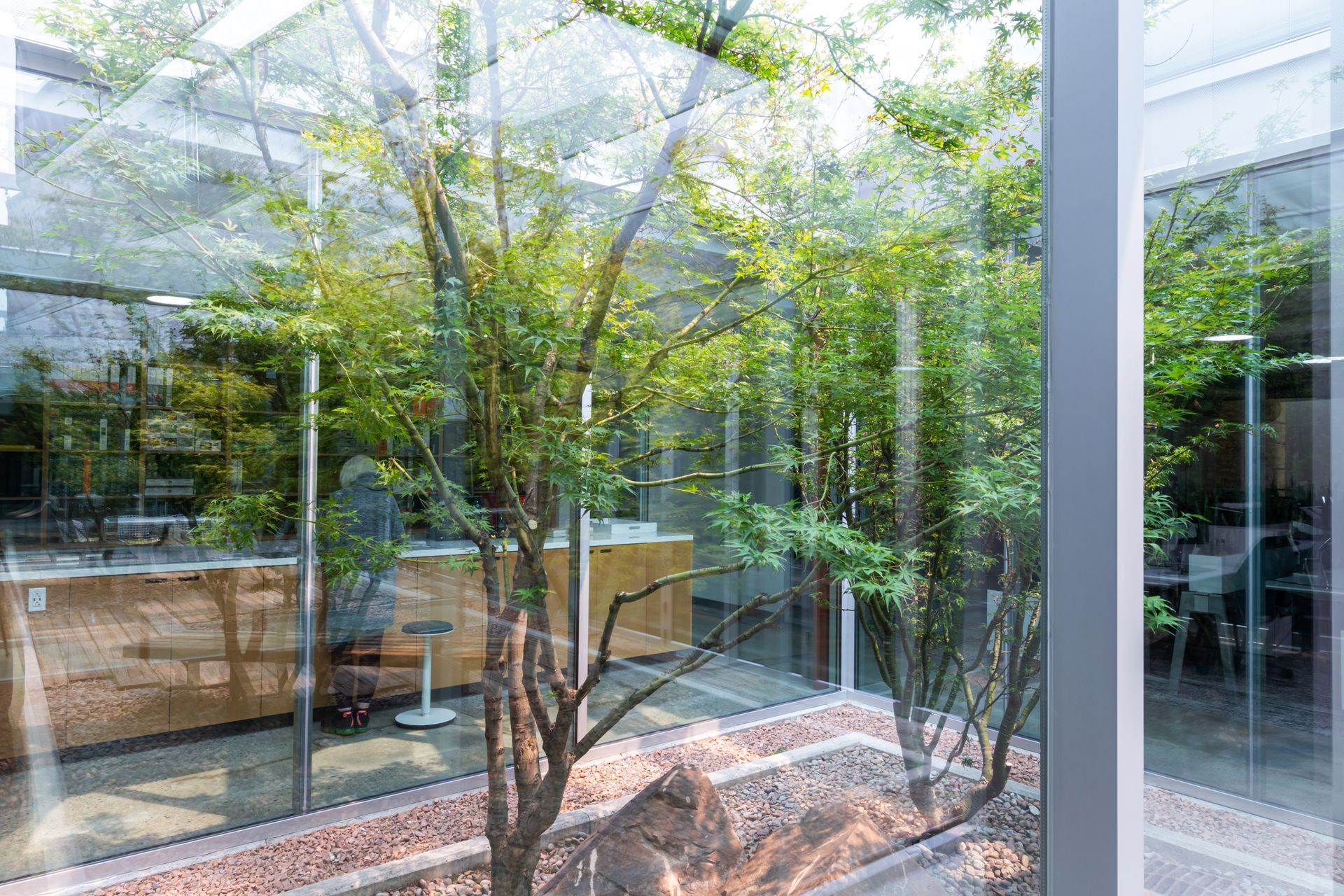
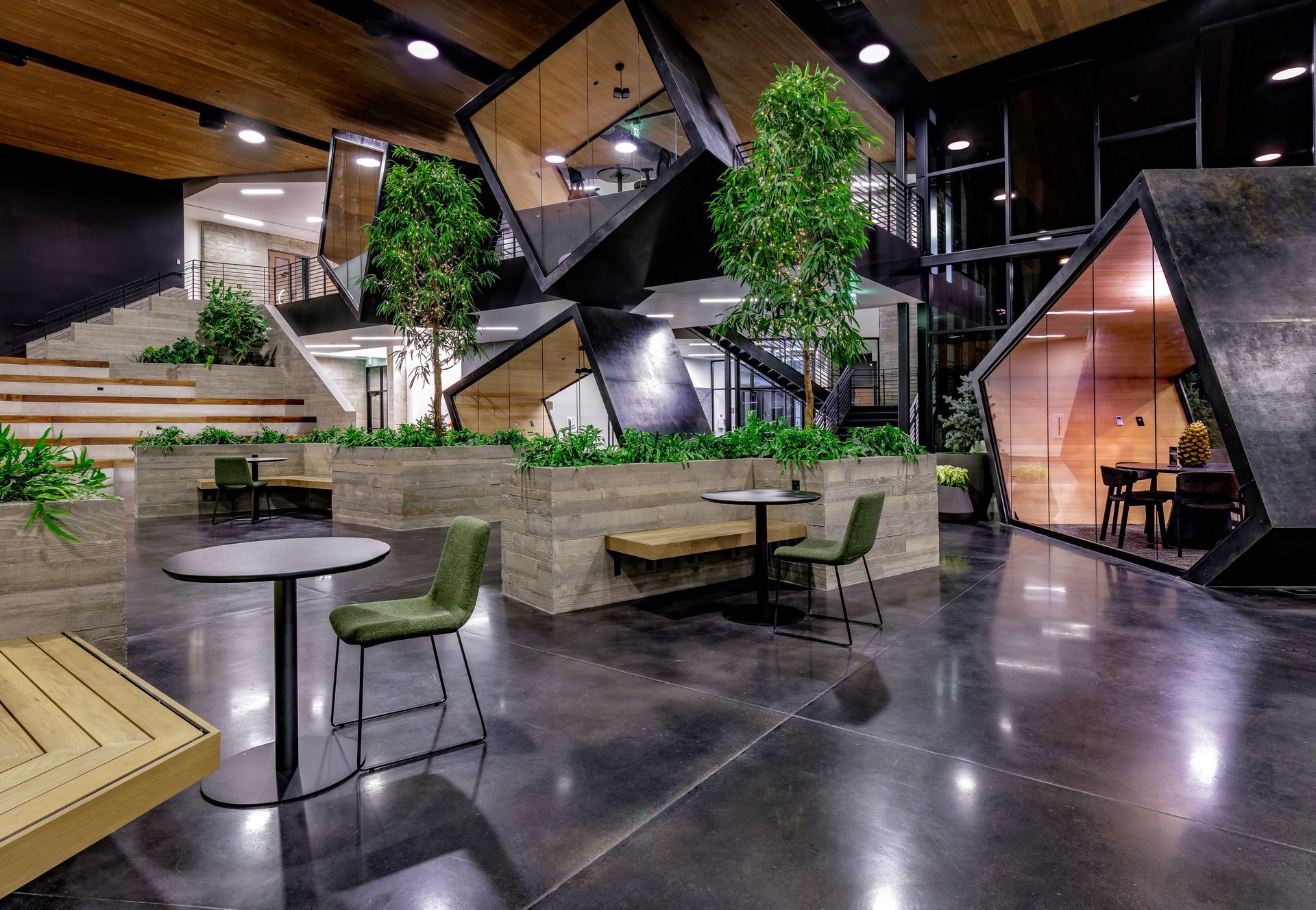
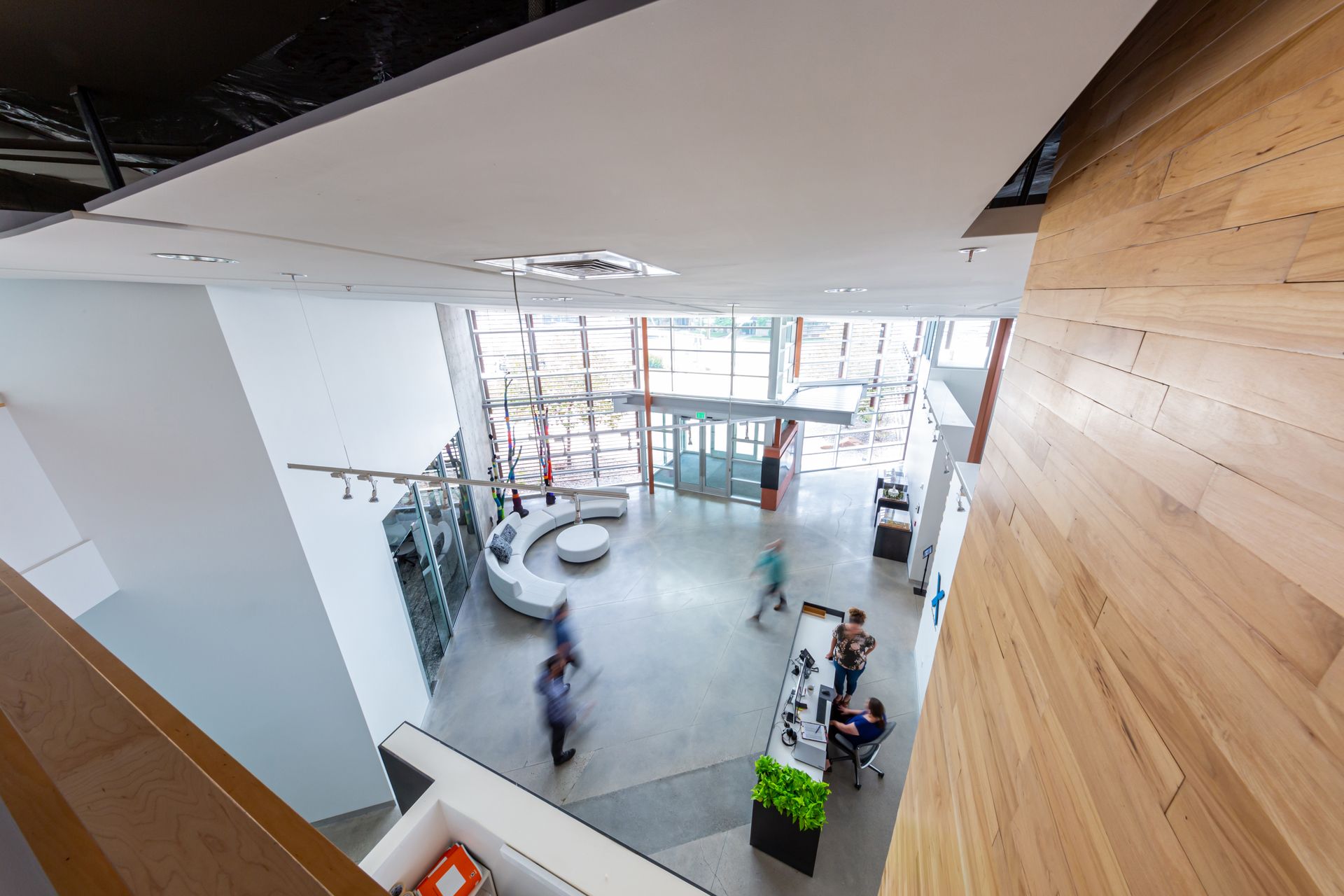
Adding courtyards and a lovely two-story lobby were two components that aided the renovation in earning LEED Double Platinum. “But we were merely sustainable,” said Kenner Kingston, a driving force behind the push for LBC Certification. He and the company wanted more.

Renovating into a Living Building

The renovation originally conceived was five remodels over five years. The Architectural Nexus team laughs at what that would have been like in retrospect—the pandemic allowed them to do the renovation in one fell swoop.

The architects enlisted previous partner Jacobsen Construction to oversee this second renovation—the same contractor that helped renovate the building in 2009. Matt Nelson, Project Manager for Jacobsen Construction, knew it would be demanding to create only the second LBC Certified building out of a renovation—the Architectural Nexus’ Sacramento office was the first project in California to earn that rarified designation. 

One would expect that such a challenge would figuratively require blood, sweat, and tears to construct regenerative systems and meet stringent performance requirements. Nelson and others said that nicks, bruises, and long days may have made that sentiment literal, too. It started with the extensive demo plan—the most extensive demo plan Nelson and his team had ever seen.

“We couldn’t demo, we had to disassemble,” he said. Nelson said this “disassembly” process was a recognition of what materials were already present in the building and cataloguing them. Then, teams removed parts of the building before weighing those materials, which had been meticulously color-coded, before sorting aspects into demolition, salvaging, donation, or recycling, or landfill.

Sourcing

As the construction teams catalogued and removed building materials, new ones were on their way. But sourcing “clean” materials was a large part of the challenge. 

“When LEED first came out, it was a big game-changer. It was hard to get VOCs, recyclables,” and other variables lined up to meet U.S. Green Building Council standards, according to Nelson. “And this is more aggressive than any LEED project I’ve ever been a part of. […] The industry doesn’t fully know how to accommodate a building like this.”

Much like a nutrition label on food, the LBC exposes what goes into our built environment. Sourcing materials like steel, wood, and concrete were no problem for Nelson and his team. They salvaged the old gym’s wood floors, one of the materials that has made it through the last two renovations. The project team also looked to localize their construction materials, finding high-quality products closest to the building’s location to cut carbon emissions from the construction supply chain—bringing “shop local” into construction’s vernacular.

Fixture submittals and other materials that required multiple components were the real challenges in sourcing. “Think about a faucet,” Nelson said, walking through the intricacies of what is necessary—sink tub, drain pieces, countertop, et cetera. “Now, do any of those pieces have chromium VI in them? Those are rejected.”

What is restricted from this building is impressive. The LBC “Red List” excludes the use of “worst in class” materials, chemicals, and elements prevalent in the building products industry—each known to pose severe risks to human health and the greater ecosystem.

As a result, there is an unexpected bit of comedy. Unlike a new book, car, or even house, “There is no smell in the new building,” according to Nelson.

Though the obstacles are evident, sourcing according to LBC standards isn’t a disadvantage—it is another way to be intentional about the choices that make up our built environment.

Creating Place


The company looked to nature for a critical component of the design.

“Nature doesn’t make single-purpose items,” said Kingston of the fundamental concept of regenerative design. Take a plant stem for instance, “It’s structure, it’s plumbing, it’s energy transfer.”


Architectural Nexus took that analogy to create an architectural vision around essentialism, where everything in the building is here because it needs to be here—no fluff.

Kingston explained, “Essentialism says ‘What if I can have two things, but what if I can do it with one?’” Much like a flowering plant, their building aimed to be full of utility, purpose, and beauty.


The greater utility of the office’s items swerves away from being stuck on specificity or minimalism. “We meet the need, and we serve a [visual] purpose,” said Karen Cahoon, Associate Interior Designer and the lead interior designer on the project for Architectural Nexus. She pointed out the new office’s cabinets, which store objects in a clean and uniform way and do so without hardware—another nod to essentialism. So, similarly, things like whiteboards in the conference rooms double as projector screens, everything is multi-purposes.


What the Building Has Grown to Be


The pandemic provided an unexpected silver lining to today’s office. Berreth and fellow Architectural Nexus Principal Robb Harrop, lead designer on the project, each described the time working from home as one where everyone stuck to the essentials and made do with whatever they had while working remotely.


The new layout is a radical change in philosophy for the firm, even if their collaborative nature has always been present. “Everyone used to ‘live in an apartment,’ and everything in that apartment was what you owned,” said Harrop of the previous configuration. “Now we’re asking you to reside in a room but live in a house. You get to enjoy all of the amenities of the conference room and breakout rooms as opposed to living in your little cubicle.” 


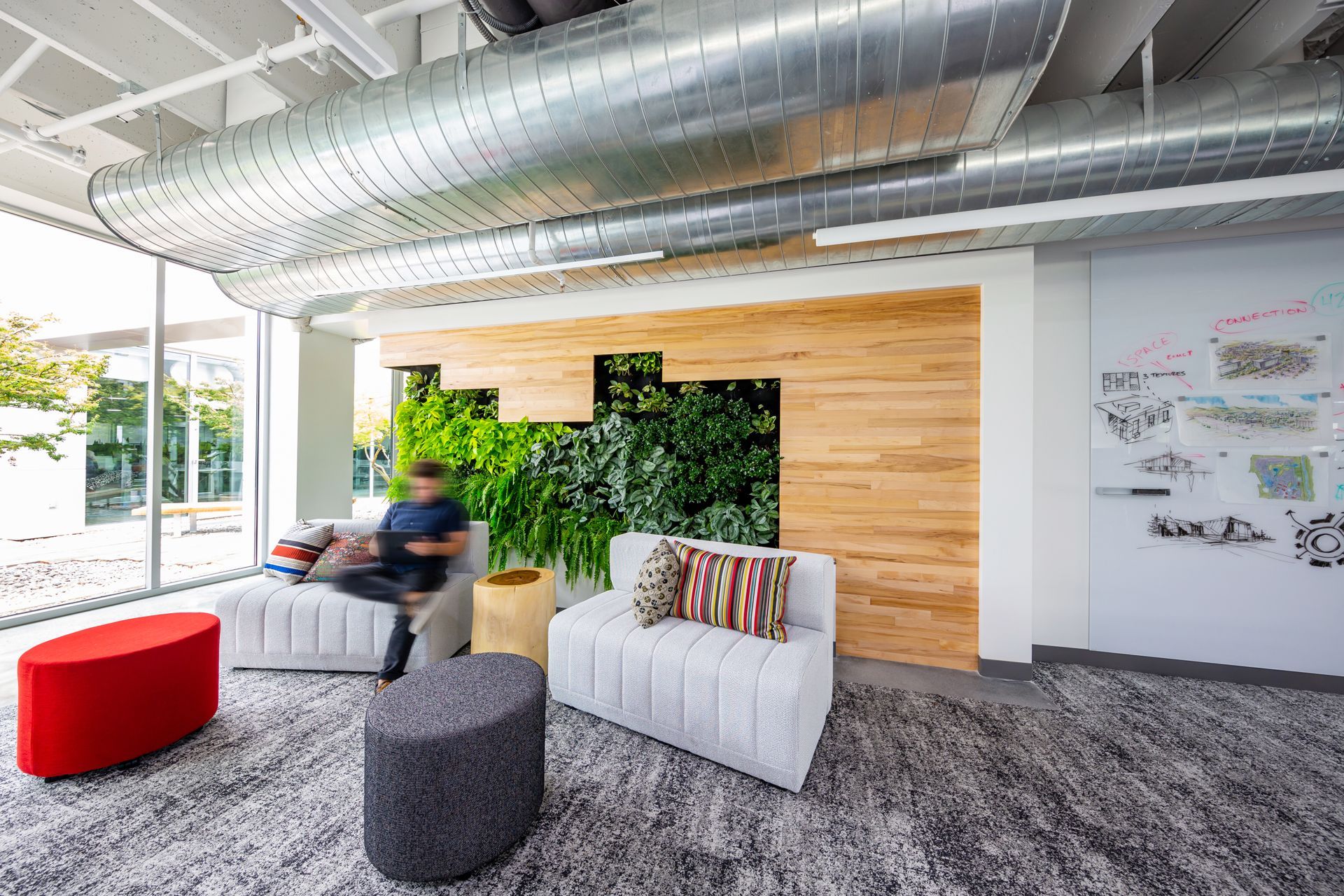
Today. people can “plug-and-play” in any of the different workstations around the 30,000-SF office, or just take their computers with them to the interior courtyards or the outdoor gathering spaces.

“It’s been fun to watch how employees act differently in the new building,” said Harrop. “People are in the courtyard sitting and moving around a lot more.” No more closed-off cubicles, no more people separated by seniority—just colleagues sharing space throughout the five neighborhoods in Arch Nexus SLC.


They can enjoy not just their firm's architectural labor, but the quiet majesty of the space. Cahoon chose a color scheme with pops of color to differentiate the six neighborhoods and provide visual interest for occupants. Chairs in the hoteling offices pay tribute to famous architects—Patricia Urquiola, Jens Risom, Frank Gehry—and furnish the right amount of whimsy for enjoying work.

Laboratory of Ideas


Those interviewed from Architectural Nexus described the new office functions as an experimental laboratory for building choices. The open concept with plug-and-play collaborative design was just one element. Natural ventilation was another.


“It’s taken us many decades to get us to think about [heating and cooling] this way again,” said Brian Cassil, Director of Communications for Architectural Nexus, concerning natural ventilation systems. It is refreshing to walk through the office and experience the natural breeze from the two indoor courtyards and their opened curtains of windows. 


Beyond natural ventilation, experimenting with daylight simulation was time well spent. Solatubes and light wells in the interior courtyards provide bounteous sunlight throughout the office and help conserve the company’s electricity bill.


The firm’s desire to be the testing grounds for new ideas also turned the office into a bit of a greenhouse—just without the swampy humidity. Data from their Sacramento office encouraged the Arch Nexus team to insert lots of lush greenery. “The ferns have been crazy from day one,” said Cassil of the plant growth. “They just go gangbusters.”


There are seemingly endless examples that move the regenerative building conversation forward. “People can come into our building and see [these regenerative elements of a building]—they don’t have to sit in a conference room and hear us talk about it and imagine,” said Harrop. “They can experience it.”


Regenerative Systems


And there is a lot to sell to clients. Harrop explained the regenerative components inside the building include the gray water system, living walls, and Solatubes. Exterior courtyards, water capturing cisterns, and PV array make up the outdoor systems.


The solar panels atop the steel parking structures generate just over 115% of the building’s electricity needs and power some electric vehicles. It’s helpful in a multitude of ways and a special treat for Cassil and others who use the EV chargers. He will never have to go to the gas station again, “except maybe for some taquitos,” Cassil laughed.

Nelson was quick to praise the subcontractors, who elevated their intentionality on such a complex project. That creativity was especially evident in one of the more dreary parts of a building—wastewater collection. Vacuum toilets waste very little water, using the gray water system instead of potable water. That water goes through quite a process, traveling through UV lights, three filter tanks of sand and gravel, and another sump before it goes to flush toilets and water the living walls and outdoor landscaping.


Architectural Nexus’ Megan Recher, Regenerative Design Specialist with Architectural Nexus, works closely to make sure systems are running as designed. Whether it is donning waders to check the gray water system or checking energy usage, she’s an integral part in meeting LBC standards to make sure that this “home” can continue to support its residents.


Resiliency


The firm’s renovated headquarters is advancing the concept of resiliency, a value gaining steam as lakes dry out around the state and temperatures oscillate between extremes.


The battery storage and solar array alone can keep the essential systems running for a week without external power. To Kingston, it’s an obvious solution beyond the self-described “hippie” concepts.


“There is a business reason for these decisions,” he said. That reason is the potential loss of thousands of dollars every hour the systems aren’t up and running to meet client demands. Recher is heavily involved in making sure electrical systems and usage are closely monitored. Various controls shut power completely off for the office computers after the last employee is out of the office for the night—no standby power usage here. 


“The difficulty isn’t in concepts or technology,” according to Cassil. These systems aren’t novel, but rarely are so many used together at once. “The difficulty is getting everything to work in harmony.”


These are all concepts and systems that are readily available and whose price is very similar to standard systems—the issue is change. Recher mentioned that the ceiling for clients is imaginary. But going above and beyond today’s standards requires curiosity and intentionality that isn’t always prioritized in the breakneck scheduling that has become the A/E/C norm.


The intentionality here feels at once unique and achievable, .

It goes back to that multi-purpose nature mentioned earlier. This building serves not just as an office but as a new way forward. A regenerative built environment is possible.


“All these things we are doing … They are not novel. They are not hard. They are not expensive,” said Kingston. “But they are critical.”


ARCH NEXUS SLC

Owner: Architectural Nexus
Architect: 
Architectural Nexus
General Contractor:
 Jacobsen Construction
Civil Engineer:
 Meridian Engineering
Electrical Engineer:
 BNA Consulting
Mechanical Engineer:
 Capital Engineering Consultants
Structural Engineer:
 ARW Engineers
Interior Design & Furniture:
 Architectural Nexus
Plumbing Subcontractor:
 Budd Rich Plumbing Inc.
HVAC Subcontractor:
 Rocky Mountain Mechanical
Electrical Subcontractor:
 Arco Electric
Concrete:
 Jacobsen Construction
Steel Fabrication & Erection:
 Clegg Steel
Glass/Curtain Wall: 
Mollerup Glass & Alder Sales
Masonry Subcontractor:
 RJ Masonry
Drywall/Acoustics:
 HD Acoustics
Painting:
 Fisher Painting
Tile/Stone:
 JRC Tile & Stone Inc
Other Specialty Subcontractors: 
Jacobsen Flooring Services, Layton Roofing, Guaranteed Waterproofing & Construction, DJ Johnson, A-Core Concrete Specialists

By Taylor Larsen February 25, 2026
Start spreadin’ the news I’m leavin’ today I want to be a part of it… I can hear everyone singing the final line: Deer Valley Resooooooooort Fine. Frank Sinatra may not have had après ski on the mind in “New York, New York”, but if the famous singer were alive today, I bet he would want to be a part of Deer Valley’s East Village—even with no relation to the New York City neighborhood—and the transformational development ongoing across Mayflower Mountain and Deer Valley Resort. East Village—Deer Valley Style “Deer Valley East Village is a long-anticipated project that will serve as the heart of the expanded terrain at Deer Valley Resort,” said Gary Barnett, Founder and Chair of Extell Development Company (Extell), in a press release. “With careful planning, we’ve curated a village that will redefine luxury and offer unparalleled amenities for our guests.” The ability to curate such luxury came from 10 years of collecting. Since 2015, Extell has purchased over 20 land parcels, assembling well over 5,000 acres for development. Extell partnered with the Military Installation Development Authority (MIDA) and Reef Capital Partners (Reef) to create a highly capable development team. These efforts set the stage for the 2023 agreement between the developer and Alterra Mountain Group (Alterra), Deer Valley’s parent company, to fold Extell’s East Village property into its existing resort operations—what Deer Valley President and COO Todd Bennett called, “Your new Deer Valley.” Barnett, speaking of what’s to come with this partnership and the billions of dollars of work set to go in on the mountain, said, “Extell and Deer Valley collaborated to craft a village and ski experience where luxury, adventure, and experience come together effortlessly.” Thus began the monumental transformation of Mayflower Mountain. Big Name Arrivals Two projects helped get the party started in the East Village. The Residences at Pioche Village delivered four buildings comprising 400-plus condominiums built by New Star General Contractors in December 2023. Although the project is outside the epicenter of ongoing development, it is becoming increasingly important to the area, as MIDA recently purchased one of the buildings to set aside 42 units of workforce housing. The first finished project within the epicenter was the award-winning Grand Hyatt Deer Valley, designed by OZ Architecture and built by Jacobsen Construction, completed in 2024. Extell partnered with MIDA to develop the hotel on military land, offering 100 rooms at a discounted rate for service members. The opulent hotel and condo property introduced a total of over 380 guest rooms, 40 suites, 55 private residences, and nearly 40,000 SF of conference space. And it’s just the beginning. On a recent tour of the East Village, Michael Woisin, Extell’s Sr. VP of Construction in Utah, detailed the immense manpower required to bring the vision to life. The six tower cranes currently operating there, along with a handful of other cranes, combine with dozens of concrete trucks heading up and down the mountain to support around 1,000 construction workers on site, driving projects of all sizes. Reef is developing multiple residential properties in the coming years. On the single-family side, Marcella at Deer Valley has already sold out the 143 homesites in the future private community, which is currently under construction. Marcella Landing will deliver a gated community of 50 ski-in/ski-out luxury townhomes designed by Olson Kundig. Cormont will deliver five residential condo towers and a vibrant central plaza, with construction completed in 2027 and 2028, and local architectural experience provided by FFKR Architects. The big brands are coming, too. Four Seasons Resort and Residences Deer Valley, designed by ODA Architecture and built by Jacobsen Construction, will deliver 134 guest rooms and suites, as well as 123 for-sale residences, with completion in 2028. Canopy by Hilton will open a 180-key hotel near Pioche Village. The property will feature architecture by The Richardson Design Partnership and interior design by DLR/Brayton Hughes and will open its doors in summer 2026. Waldorf Astoria Deer Valley Resort and Residences was announced in late January, with plans to bring 132 guest suites and 105 for-sale residences near Deer Valley’s Green Monster, the resort’s 4.85-mile ski run—Utah’s longest. With architectural design from KPF and interiors by AvroKO, the project will open its doors in 2028. Beyond the ski-in/ski-out access at many of the above properties, the East Village will also feature a skier services building and an extensive, tiered pedestrian plaza designed by ODA for year-round enjoyment when completed. The building will serve as the heart of the ski village, surrounded by the “ski beach” at the base of the mountain—with a future holiday market, a snow maze, and The Ribbon’s state-of-the-art ice- skating circuit planned for winter months. In summer, the area will be activated by a music festival, farmer’s market, outdoor movie screenings, and other events.
By Bradley Fullmer February 25, 2026
If the turnout for the 104th Annual Convention for the Associated General Contractors (AGC) of Utah is any indication of the current state of the construction industry in the Beehive State, 2026 will indeed be a robust year. The popular industry convention—held January 29-30 at Little America Hotel in downtown Salt Lake—continues to draw room-busting crowds at its events. The AGC's 2026 Awards Breakfast kicked off the convention on January 29, with the Utah chapter handing out nearly 50 awards for innovative projects and dedicated people. The second day—an all-day event—included entertaining keynote speakers at breakfast and lunch, along with informative breakout sessions in between. The convention was capped by an always-entertaining Installation Banquet, where Gary Ellis, President/CEO of Salt Lake-based Jacobsen Construction, was installed as 2026 AGC of Utah Chairman of the Board. Brett Nielsen, President of Brigham City-based Whitaker Construction and 2025 AGC of Utah Chairman, thanked AGC's staff of 13 for their efforts to elevate the association, and highlighted the work of the Construction Learning Committee (CLC), which aims to cultivate the next generation of construction industry leaders. "Earlier today, I made a comment that the generation that's coming into our industry today is about 20% of our population, but they are 100% of our future," said Nielsen. "We owe it to them to make sure we're providing the same tools, the guidance, the leadership that we received as we were coming up in the industry." Ellis followed with an initial plug for Nielsen, who is in line to serve as the AGC of America's 2030 President—a first for the Utah chapter. "We're excited to share Brett and his wisdom and terrific leadership to the entire country with regard to our industry—he'll do a great job and carry Utah in his heart," said Ellis. Ellis said he never imagined working in the construction industry, thinking he'd rather be a river running guide or physical therapist. Ultimately, he pursued accounting, earning a Master of Accounting from Provo-based Brigham Young University in 1995 and spending the first five years of his career as a Senior Auditor for KPMG in Salt Lake. He was hired in December 2000 at Jacobsen Construction as a Financial Controller, later ascending to his present title of President/CEO in January 2021. "The amount of construction experience I had before I landed at Jacobsen Construction was two weeks sweeping floors at a residential construction site," said Ellis. "I never imagined I would be part of the construction industry, but it's been life-changing for me. Our theme for the convention this year is Building What Matters—I wanted to do something that mattered [...] I wanted to be part of growing something, something I could put my arms around and say, 'wow, look what we just did together'. That's really what my motivation was when I found the construction industry." During the first five years of his career at a large corporate firm, Ellis said the gig lacked fulfillment. Joining Jacobsen opened his eyes to a new world, one he quickly gained a true passion for. "My kids are sick and tired of me pointing out every [Jacobsen] building as we go up and down I-15, I-80—I know, I'm preaching in the choir. There are incredible things that we do at Jacobsen; quite often, we talk about the 'wow factor'. That is what we have in this group. It is the wow factor, being able to [bask] in the pride we feel." Ellis also thanked his team at Jacobsen for believing in the AGC's mission and recognizing the importance of giving back to the industry. "I'm indebted to Ted [Jacobsen] and his family for what they've created at Jacobsen. The day I was asked [...] to take over as President, my very first phone call was to Ted Jacobsen [...] to let him know that I commit to making sure his family name is known in good standing in this marketplace."
By Taylor Larsen February 25, 2026
Time is running out. Not for Utah water. Not yet. But it is for negotiations on the Colorado River. Recently, Utah and six other states, Mexico, and Native American Tribes missed another deadline to revise the current Colorado River Compact. Like family members negotiating a handwritten will, their agreement, or lack thereof, will determine who gets what from the Colorado River in 2026 and beyond. The compact has dictated water rights for the Upper Basin states of Utah, Colorado, New Mexico, and Wyoming, and the Lower Basin states of Arizona, California, and Nevada since it was signed in 1922. The agreement, a result of phenomenal collaboration and compromise, has worked out as well as something written 100 years ago could. But the compact is starting to look it’s age. As the desert sun is unkind to the skin, the prolonged megadrought of the American Southwest has been unkind to the Colorado River. Overallocation of the river, droughts, drastic population growth, and a lack of consideration for all of the water-drawing entities mean compromises are on the horizon to ensure that each party at the table can provide Colorado River water to the estimated 40 million people who rely on it. The seven states and the federal government have tried previous facelifts with federal guidelines and plans to draw less water, but blemishes remain. Native tribes are still awaiting corrective surgery to remove the scars of historical injustice, especially after the Supreme Court ruled in 2023 that the federal government was not required to take steps to ensure the tribes’ water rights. While Colorado River negotiations reach the end, four of Utah’s biggest water conservancy districts are pushing past existential drought to create solutions with their water users and industry partners to ensure taps flow for generations to come.
By Taylor Larsen February 25, 2026
Little did the team at KMA Architects know how much a proposal for one high school would change their fortunes forever. Duchesne School District released its RFP for a new Altamont High School in 2011. Wes Christensen, then Project Architect, felt like it was a winnable project. After all, KMA Architects had built a stellar reputation designing schools throughout Utah since the firm opened in 1996. There was just one problem with this RFP: KMA didn’t design new high schools. While the firm focused primarily on elementary and junior high schools, Christensen and others on the KMA team were confident in their design proposal and threw their hat in the ring to win the job. “I was certain our competition was going to present a two-story high school,” said Christensen, recalling the various brainstorming sessions that hinged on how to best present their design for a durable and economical one-story school with easily accessible mechanical mezzanines over the corridors. The district's response had the KMA team ecstatic: “We love it.” Winning the Altamont High job with a one-story design is one of many examples of KMA’s emphasis on listening first, a legacy established long before the firm relocated its headquarters in 2020, and long before the team sat for this interview, overlooking Spanish Fork Main Street from their stylish second-story conference room. Sometimes two stories are best, and KMA’s history is among them. Starting Shop in Provo It starts with Kevin Madsen initially pursuing engineering at the University of Utah, graduating in 1972, but with a passion for the entire industry. He earned his contractor license in 1974, but he made his mark in design. “I was good at drawing and drafting,” Madsen, now retired, said from the comfort of the drafting table of his Palmyra home. Madsen even taught drafting and CAD at the former Utah Valley State College (now Utah Valley University) from 1990-1993, saying, “That’s when I realized I wanted to run an architectural firm.” After Nebo and Sevier school districts personally requested Madsen’s services, he founded Kevin Madsen & Associates Architects in January 1996, bringing Christensen and others to work on the firm’s many projects. One of which began when Madsen bought a historic Victorian home at 195 East and 100 North in Provo and turned it into the KMA office in 1998. “It was a work in progress all the way,” laughed Madsen over the phone. That contractor license came in handy; Madsen salvaged high-quality carpet scraps from schools and brought them back to the office. Christensen, now KMA’s Owner and Principal, remembered sanding beams, tearing out old carpet, and stapling in the new flooring in its place—he’s got the scars to prove it. Other famous memories the entire senior KMA team recalled involved creating original blueprints with ammonia and venturing up I-15 to the old Service Blue print shop in Salt Lake to print off dozens of client copies. “We called it a ‘Printing Event’,” Christensen said, recalling the various times that the team would yo-yo between Provo and Salt Lake to drop off their specifications and drawings, often at midnight or later, before returning the next morning to fill an entire truck bed with boxes of freshly printed copies.
By Taylor Larsen February 25, 2026
The new Weber Blackstone headquarters project involved significant civil work in dewatering and wetland preservation so close to Big Ballard Springs and Blacksmith Fork River. Once completed, the finished build’s Prodema wood paneling exterior gives the building take-off. (all photos courtesy R&O Construction except where indicated)
By Taylor Larsen February 25, 2026
Midlife crisis? Try mid-life calm for New Star General Contractors as the Salt Lake-based construction firm celebrates 40 years of building great projects. As President Jeff Pettit sits in the firm’s conference room on the second story of the New Star office (self-performed in 1996), he reminisces on his 37 years there, as well as plenty of lore established when the firm emerged. In 1986, carpenters Dave Love and Steve Williams were building a home for their boss’s lawyer in Salt Lake City’s Federal Heights. Their boss, Ranch Kimball, was the owner of Cannon Construction, and announced he would be closing shop later that year. Love and Williams vowed to continue the good work, but under a new venture—New Star General Contractors. Based in Bountiful, New Star performed any small project or remodel they could, even venturing east to remodel an Episcopal church in Vernal. The two owners ran New Star from a “carpenter’s perspective”, Pettit said with a smile, “A good, honest trade.” As employees gained a deep understanding of fieldwork and constructability, New Star self-performed much of the concrete, framing, and interior and exterior finishes, buoyed by a large pool of high-level union carpenters from Utah Carpenters Union Local #184, ready to build. Pettit came aboard New Star in 1989, joining his father and uncle at the firm, two journeymen union carpenters, while he apprenticed as the company grew. Early Years; Midlife Struggles Pettit praised the foundation established by Williams and Love in New Star’s first decade, recalling how both owners worked as estimators and project managers as they sought to win work, while Treasa Love and Patti Williams, Love and Williams’ respective wives, ran accounting, billing, and payroll. The firm was at the cusp of taking off when Williams passed in 1997, but Love and the few dozen members of the New Star team pressed on, working for Deer Valley’s former parent company, Royal Street, on projects like Royal Plaza and Goldener Hirsch Phase 1. “Those projects helped put New Star on the map,” Pettit said. Another foundational project was Peace House, a four-bedroom domestic violence shelter for women and children built in 1995. “It was Dave’s way of giving back to the community,” said Pettit of the relationship between New Star and Peace House that has burned brightly ever since. Love joined the organization’s board of directors, and New Star built Peace House’s 40,000-SF expansion over 20 years later—a massive upgrade that delivered eight units of emergency shelter and 12 units of transitional housing for mothers and children. The project, a monumental community victory, eventually earned UC+D’s “Publisher’s Pick” award in 2019. Company culture in those early years benefitted from the “New Star Band”, a six-member ensemble of New Star employees. Love, his office wall lined with a notable guitar collection, led the charge. “Dave was a great musician and a great guitarist,” said Pettit of the culture- and relationship-building efforts of the New Star Band. “Anyone who knew New Star knew of the band.” But it wasn’t all roses, as New Star’s union roots counted for little as the firm and many other general contractors battled trade unions in the early 2000s. Pettit recalled the picket lines that formed around their Salt Lake City office and their job sites. As the Great Recession hit in 2007 and dragged on into the next decade, Pettit grimaced at how New Star laid off many employees as he, Love, and the remaining executives took massive pay cuts, following through on Love’s advice: “Keep money in the company, because there will be lean times.”
By B. H. Wright February 25, 2026
When it comes to classy sophistication, the sparkling new Delta Sky Club—Concourse B at Salt Lake City International Airport sets an incredibly high bar in both form and function. The opulent 34,000-SF club—Delta's second at The New SLC—offers members myriad ways to relax and decompress from the rigors of travel, highlighted by the truly unique Digital Immersion Room. Salt Lake-based HOK worked with Zenapptic of Novato, Calif., on the impressive display, which was designed with neuroinclusive principles in mind. The innovative space surrounds guests with seven expansive screens featuring aerial views of Utah’s iconic landscapes, including the state’s five national parks and cityscapes of downtown Salt Lake architecture. Synchronized natural soundscapes enhance the visuals, creating a calming, immersive, and four-dimensional experience. Velvet drapery, darker tones, and curved acoustic baffles further support the sensory environment. As the only club in Delta’s network to offer this experience, Salt Lake City sets a new benchmark for innovation and traveler comfort. "We wanted it to feel like a cocoon, a space you can get away from the hustle and bustle, even from what's going on within the club," said Sarah Oppenhuizen, Director of Interiors at HOK. The seven screens are tied into the speaker system, "so you're hearing birds chirping, or a plane flying by, or a storm rolling in. Zenapptic did a fabulous job of taking these scenes, images taken all across Utah, and splitting them into layers [...] that can move in a way that makes it feel like you are actually viewing that scene." The material palette and lighting selections also reflect and amplify Utah’s natural beauty. From warm tones to reflective surfaces, every detail connects travelers to the spirit of the state. The club itself is a diverse wonder of breathtaking spaces created from a highly curated and layered material palette. Each space was meticulously crafted into "neighborhoods" appealing to myriad client tastes and preferences. There are eight specific ceiling systems, eight custom terrazzo blends, a dozen tile products, and dynamic specialty lighting—creating a refined ambience inspired by Utah’s diverse landscapes while maintaining the elevated experience synonymous with Delta's iconic brand. The distinct neighborhoods highlight the club's supreme functionality supporting a robust 600-seat capacity—it's Delta's second-largest club after La Guardia in New York City—while maintaining comfort, intuitive circulation, and a soothing acoustical environment. Larger-scale stone flooring with red accents evokes a natural hiking path while providing durability and ease of movement for guests with rolling luggage. Sound-absorbing properties are integrated into ceilings and select walls throughout the space to maintain a serene guest experience. “Creating distinct neighborhoods gave us the flexibility to increase seating capacity without sacrificing comfort,” said Mishael Thompson, Design Lead at Delta Air Lines. “Guests can easily find a space that fits how they want to travel—whether that’s social, private, or somewhere in between.” “The goal was to bring a true sense of place into the space without overwhelming the guest,” added Oppenhuizen. “By layering materials, color, and technology, we were able to reference Utah’s landscape in a subtle way while maintaining the timeless, hospitality-driven feel of a Delta Sky Club.” Design elements on Level 2, which serves as the entry experience, incorporate cooler whites and blues inspired by a Park City winter, while Level 3 transitions to warmer reds and bronze tones that reference Utah’s caves and caverns. A signature seating area at the top of the escalators—featuring layered blue furnishings and a rippled metal ceiling—draws inspiration from the Great Salt Lake. An expansive, curving bar is an eye-catcher—a unique reflective ceiling above with twinkling lights is a highlight that recalls the state’s copper mines. Blue-veined marble countertops in the space reflect crystal-like light fixtures reminiscent of stalactites, adding a sense of natural wonder. Emphasis on High-Quality Finishes, Resort-like Feel Maintaining the Delta brand is always a top priority for designers, and while explicitly branded elements in Delta Sky Clubs are minimal—primarily limited to the check-in area and select touchpoints—the broader brand strategy centers on elevating the airport experience through high-quality design, materials, and comfort. Branding is subtly expressed through a hospitality-driven environment that conveys both luxury and durability. “We want all our guests to feel like they’ve just stepped into a high-end hotel lobby—not an airport,” said Thompson. “That sense of arrival, comfort, and quiet luxury is fundamental to how we think about the Delta Sky Club experience, and this project truly delivers on that vision.” While program standards remain consistent across all Delta Sky Clubs to ensure familiarity, hub locations such as Salt Lake City provide opportunities to further elevate the experience through regionally inspired materials and design cues. This balance of consistency and localization reinforces Delta’s brand promise while allowing each club to feel distinctive and connected to its location. The new club is larger than its sister Delta Sky Club in Concourse A—that one checks in at 29,000 SF. The expanded footprint provided opportunities to further elevate the experience through additional amenities, greater spatial variety, and a stronger emphasis on regional design elements while still maintaining consistency with Delta’s established Sky Club standards. Attention to detail is a Delta hallmark, added Thompson, with high-quality finishes essential to the project's overall aesthetic. Achieving this level of quality required extensive coordination, including detailed submittal reviews to ensure each material and design element met Delta’s performance and durability standards. Attention to craftsmanship played a critical role in delivering a club that aligns with Delta’s elevated brand experience. “Our guests notice the details,” Thompson emphasized. “From the durability of finishes to how materials feel and perform over time, quality was non-negotiable on this project.”
By Bradley Fullmer February 25, 2026
Dejan Eskic was blunt in his assessment of Utah's 2026 economic outlook during a January 13 presentation to the American Concrete Institute (ACI), Intermountain Chapter, remarking in his opening statement, "I feel like we're living in a season of the [television] show '24', where every episode, you're holding your breath." Eskic, Sr. Research Fellow at the Kem C. Gardner Policy Institute at the University of Utah, was talking about geopolitics, specifically referencing the economic impact of the Trump Administration’s global tariffs after a year, and how economic outlooks are not so easy to predict when dealing with the potential impact of national and international factors. "Part of talking about economics, it can get political," he continued. "I try not to be political about it, but it's hard to unravel the two, right? Whatever [information] President Trump releaes on whatever media platform has influence on the market. Tariffs really brought a lot of uncertainty and made the market very skittish." Eskic said tariffs are his "least favorite subject, because we haven't had to talk about it for 100 years, and all of a sudden it's gone haywire—there's a lot of uncertainty with tariffs." He added that the Gardner Policy Institute will release a white paper detailing tariff impacts later this year. Interest Rate Cuts Not Anticipated in 2026 The Fed did not cut interest rates at its first meeting of the year on January 28, and Chair Jerome Powell believes keeping the current rate of 3.5% to 3.75% is prudent, with stabilizing unemployment and inflation rates signaling a steady economic year. "Employment rates have stabilized to the point where they're not forecasting a rate cut. I think they're anticipating steady rates between 3.5% and 3.75%," said Ryan Starks, Executive Director of the Economic Development Corporation of Utah. "Just having that predictability is the most important thing." Home mortgage rates took a sharp dip in January, Eskic reported, from 6.8% to 6%, which is something "you pay attention to" considering it happened in just a few days. Steady rates mean developers know exactly what to expect and can determine whether or not to pull the plug on projects that have been paused while more favorable rates are seen. Utah Expected to Have Moderate Economic Growth Eskic cited the Gardner Institute's 2026 Economic Report to the Governor when announcing a slew of favorable projected stats that underscore moderate 1.5% economic growth, including: • Steady job growth of 1.5%, including a robust 3.2% construction job growth (143,000 jobs); • Rising average wages of 3%-4%, with some construction trades expected to eclipse 5% wage growth; • Continued population growth, albeit at a slower 1.3% clip overall; Utah County led the way with 2.1% growth; • Low state unemployment rate of 3.3% in 2025, significantly better than the national average of 4.4%. While these numbers are down from peak totals within the past decade, they still portend a growing economy, with construction playing a vital role in the state's overall economic health. AGC Optimistic for Another Solid Year The Associated General Contractors of Utah (AGC of Utah) remains a steady voice for construction in the Beehive State, and its members "are cautiously optimistic about 2026, with the strongest confidence in infrastructure, power, and data-driven projects," said Joey Gilbert, AGC of Utah President/CEO, citing his association's record-level 700+ members statewide as an indicator of the health of the industry. “Utah's biggest structural advantage is that it's still a growth state with strong population gains and job growth creation with durable demand for housing, commercial space, and public infrastructure," added Robert Spendlove, Chief Economist for Zions Bank. "We also benefit from a relatively healthy labor market and strong household fundamentals. Utah's unemployment rate (hovering around 3%) remains lower than the national average (4.4%), and wage growth has been running above the U.S." That's not to say everything is peaches and cream, as job growth "has cooled compared to the post-pandemic surge," said Ken Simonson, AGC of America Chief Economist. "Contractors are still dealing with labor pressures, wages are expected to keep rising 4%-5%, and policy actions affecting labor availability could make staffing harder in 2026. At the same time, the national data show job openings have fallen, which is consistent with a market that's still tight in key trades, but less overheated than a year or two ago." Gilbert agreed that construction labor in Utah has steadied a bit, saying "the labor market is still tight but stabilizing, with steady wage growth and increased focus on workforce development and retention." There are other tailwinds in Utah's favor as 2026 begins. Spendlove said, "Utah's underlying economic fundamentals remain strong: population growth (about 1.5%) and employment growth (north of 2.0%) are still outpacing the U.S., which supports a steady pipeline of construction demand. “ Simonsen agreed that Utah remains a hot business market—yet again—to have another solid year. “Utah remains resilient. The opportunity set in 2026 looks best where demand is most durable—data centers, power, and infrastructure. Utah is well-positioned to compete [nationally] in those areas. Even with uncertainty, contractors are planning, not freezing. The main watchouts are financing conditions and cost volatility, but there's still meaningful work in the queue.” Gilbert added, ”Utah's construction industry is well-positioned in 2026 due to strong economic fundamentals and sustained demand in key sectors.” Demand Brisk for Data Centers, Infrastructure, Energy, Other Markets Contractors and designers recognize the rapidly rising demand for data centers, and therefore, the energy to drive power-thirsty—not to mention water-thirsty—projects, and are positioning themselves accordingly. Utah Governor Spencer Cox has "Operation Gigawatt" rolling, a 10-year initiative started in 2024 to develop new energy production across multiple power sources. "It's absolutely essential that we get in front of energy," said Starks. "We're seeing that from a population growth standpoint, but also from a commercial growth standpoint. With more development taking place, somebody's got to take the lead, and we feel like Utah is well-positioned to be that leader. The Governor wants to double energy production as part of the 'Operation Gigawatt' initiative. Our approach to energy is an 'all-of-the-above' approach—natural gas, solar, nuclear, geothermal." Gilbert said Utah's legislative leaders are keen to see Governor Cox's energy ideas come to fruition. "Their priorities are energy production and reliability," said Gilbert. "Senator [Stuart] Adams believes the state that controls AI will control the world. AI demands power and a lot of it. [State legislators are] dedicated to making sure Utah has infrastructure and power resources. We're looking at energy resources, from nuclear to solar and everything in between."
By Bradley Fullmer November 15, 2025
Residents have access to a wealth of modern, high-class amenities: Check out this open-air rooftop patio with tasteful lighting, pool, and spacious hot tub—it’s party time! (all photos courtesy Kier Construction)
By LADD MARSHALL November 15, 2025
Steve Green is out in McCornick, Utah. Where is that? And what’s near McCornick? “Nothing,” joked Green, the Sr. Vice President for Wheeler Machinery Co. While he may be far from even the smallest of small towns, with Holden and its 492 residents 13 miles away, he’s close to the site of a major development in data center technology. Isolated on the western edge of the Sevier Desert, the Joule Data Center will also be isolated from the grid—by design. Operation Gigawatt Rolls On Green is one of many energy and power professionals hoping to double Utah’s power generation capacity by 2034 as a part of Operation Gigawatt, an initiative launched by Utah Governor Spencer Cox in October 2024. Utah has long been an economic growth leader; Operation Gigawatt aims to make Utah a power player in energy development by increasing transmission capacity, increasing energy production, strengthening policy, and investing in energy innovation. While Governor Cox’s Operation Gigawatt moves forward statewide, out in McCornick, Green said, “We’re doing operation gigawatt and a half off grid.” The Joule Data Center project team will deliver “In-situ power generation”—power not connected to any electrical distribution or transmission system. It starts with Caterpillar G3520K reciprocating generator sets that produce 1.5 gigawatts of electricity. Waste heat and exhaust from the generators then move through an absorption chiller system as part of the overall systems combined cooling, heat, and power (CCHP) solution, providing much of the water required to cool the data center servers. Beyond the electric power to be generated for the Joule project, there will be 1.5 gigawatts of thermal energy and 1.1 gigawatts of available battery storage to meet the data center's peak electricity needs. Added Green, “And we’re not taxing the local utility grid.” Isolated or Community Power? The massive power capabilities delivered there are impressive, but they reveal a troubling trend in how Utah will double its power generation capabilities. Will it be from well-funded companies looking to power data centers and AI technology separate from the grid? Or will Utah fulfill the mission of Operation Gigawatt by creating power solutions accessible to all? According to Troy Thompson, Chief Operations Officer for Big-D Companies, power generation is about more than supplying data centers. “In my mind, how do we build a billion-dollar hospital downtown that needs ten megawatts of power?” he said, referencing Intermountain Health’s future downtown Salt Lake campus, “let alone the data centers, and manufacturers who we are hoping that will come here?” Ten megawatts of power may pale in comparison to what data centers require, but it is one of many projects seeking regulatory approval to move forward. The Utah Inland Port Authority, the Economic Development Corporation of Utah, and others continue to drive projects and jobs into Utah—data centers, too. But Thompson said he has heard from many potential clients who are hesitant to bring their energy-intensive projects to the state without firm guarantees of available power. Operation Gigawatt and state leaders have embraced an "all of the above" approach to energy sources, extending the design lifespans of coal plants, embracing new technologies and power sources, and developing new power-generating capabilities. While the industry is willing, the operating environment needs rewiring to meet state goals. Changing for 21st Century Needs “With as hot as the Utah market is,” began Eric Haslem, “there are too many obstacles for us to overcome.” The market may be ready to ramp up production, said Haslem, Chief Operating Officer for Vernal-based utility and heavy civil contractors BHI, “But the current system can’t handle it. We have this massive web of transmission and distribution infrastructure that was not designed or built for the power demands of the 21st century.” “In 1970, they didn’t know what a smartphone was,” Haslem said, “let alone AI.” Transmission projects have been developed. Rocky Mountain Power/PacifiCorp’s Energy Gateway South transmission line—a 416-mile, high-voltage 500-kilovolt transmission line that runs from Mona to Medicine Bow, Wyoming—certainly helped when it went live in 2024. Still, it's just one project amidst a plethora of needs. Haslem stated that Utah's growth over the last 10 years meant a large majority of the transmission line's capacity was accounted for when it went live. .